Alt Life Podcast • Episode Essay
Anxiety Isn’t the Problem. A Dysregulated Nervous System Is.
In this episode of Alt Life, I speak to Dr. Ela Manga about breath, burnout, and nervous system regulation — and why so many well-intentioned tools are quietly keeping us stuck.
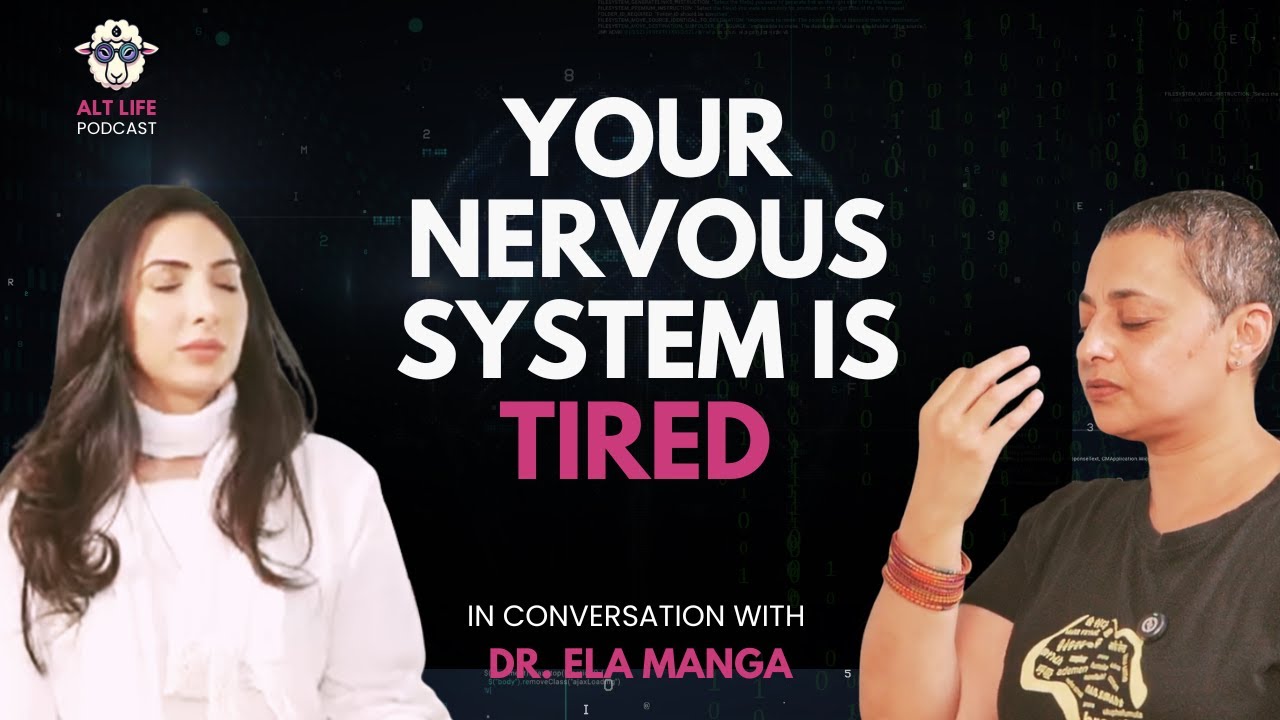
▶ Watch this episode on YouTube
We live in a culture that treats anxiety like a malfunction. Something to suppress, override, optimise away, or “fix”.
But anxiety isn’t a standalone problem. It’s often the surface expression of a nervous system that has been living in survival mode for far too long.
In this conversation, Dr. Ela Manga — medical doctor and breathwork practitioner — helps us reframe anxiety, burnout, and even illness itself through the lens of nervous system intelligence.
Anxiety is a “soup” of unfelt emotion
One of the most powerful reframes in this episode is the idea that anxiety isn’t a pure emotion.
Fear, anger, sadness, joy, grief — these are core emotions with clear physiological signatures. Anxiety, on the other hand, is often what happens when emotions are unnamed, unexpressed, and held in the body.
When we don’t have the capacity or safety to feel what’s actually present, the nervous system stays activated. Anxiety becomes the background noise.
When we learn to name and map sensations in the body, those emotions can finally move. And when emotion moves, anxiety loses its grip.
Burnout is not laziness — it’s often freeze
Burnout is usually framed as prolonged fight-or-flight. And while that’s true, it’s incomplete.
When stress becomes overwhelming and escape isn’t possible, the nervous system often shifts into a freeze response.
Freeze is protective. It’s the body’s way of saying: this is too much.
In lived experience, freeze can look like procrastination, withdrawal, disconnection, scrolling, and a deep sense of shame. But none of this is a character flaw.
It’s a nervous system adaptation.
Why hustle culture is a deception
Hustle culture sells the idea that pushing harder will eventually give us freedom, fulfilment, or peace.
But when we look at the nervous system, the story falls apart.
Giving the best hours of our day — and the best years of our life — to constant output keeps the body locked in survival. We sacrifice regulation now for a promise of rest later.
And often, when “later” arrives, the nervous system no longer knows how to rest.
Hustle culture isn’t improving our lives. It’s disconnecting us from them.
The “pop a pill” mindset has infiltrated wellness
One of the subtler insights in this conversation is how the medical quick-fix mindset has quietly made its way into lifestyle tools.
We now approach breathwork, meditation, and nervous system practices the same way we approach medication: Do the thing. Get the result.
But regulation doesn’t work that way.
When breathing techniques are imposed without context, they can actually increase dysregulation — especially for already stressed systems.
Correct breathing signals safety
Breath is not about forcing calm. It’s about signalling safety.
In the episode, we unpack why instructions like “breathe into your belly” don’t make anatomical sense, and how true diaphragmatic breathing is three-dimensional, relieving strain in the neck and shoulders.
When breathing reflects safety, the nervous system no longer needs to stay on guard. Regulation becomes possible — not as a performance, but as a baseline.
Why most breathwork sessions miss the point
Many modern breathwork practices have been extracted from ancient traditions without their original context.
Technique becomes the focus. Sensation, capacity, and integration are sidelined.
As Dr. Manga explains, we can’t force ourselves into healing or enlightenment. The nervous system needs to be able to hold expanded states — slowly, safely, over time.
For the science geeks: breath and neurobiology
We also explore the neurobiology of breath — the vagus nerve, the endocrine system, and how these networks map surprisingly closely to ancient chakra models.
Science isn’t replacing these frameworks. It’s catching up to them.
When we understand the body as an interconnected system, regulation stops being mysterious. It becomes intelligible.
Listen to the full conversation
This episode is for anyone who has tried to manage anxiety, optimise productivity, or “do the right things” — and still feels dysregulated.
Anxiety doesn’t need suppression. It needs safety, space, and understanding.